
P90X Workout: Where to Buy
P90X is a 90-day home fitness program created by trainer Tony Horton and sold by Beachbody, the company now operating as BODi. It first aired as an infomercial in 2004 and proved you don’t need a gym to get extreme results: by November 2010 it had sold more than 3 million copies, according to the American Council on Exercise.
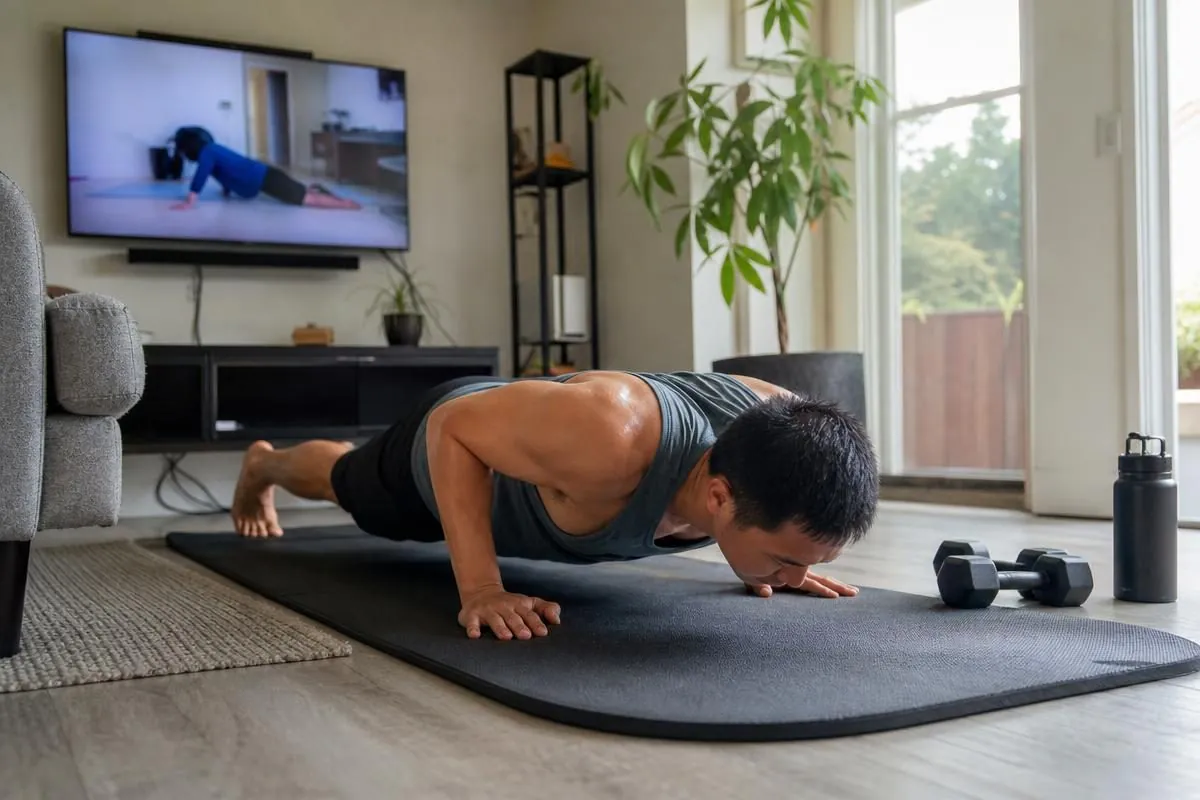
What Is P90X?
The name is short for Power 90 Extreme. It’s a total-body system of 12 workouts that rotate 6 days a week, roughly an hour a day. Horton built it around muscle confusion: changing moves often enough that your muscles never adapt, which is how the program tries to break the plateau that stalls people on a fixed routine. Exercise scientists call the idea daily undulating periodization.
The rotation mixes resistance days, cardio such as Plyometrics (jump training) and Kenpo X, and recovery work like Yoga X and X Stretch. Ab Ripper X, a 16-minute core routine, follows strength sessions three times a week. Horton later fronted two sequels, P90X2 and P90X3, the latter built on 30-minute sessions.
Streaming on BODi or the Original DVD Set?
Streaming is the simplest route today. Beachbody (rebranded as BODi) includes the program in a BODi subscription alongside its other fitness and nutrition programs, with the calendar and eating guidance built in.
The 12-DVD set, which retailed for about $120 when ACE reviewed it, still sells new and used. Discs make sense if your internet is unreliable or you’d rather own the workouts. On a used set, confirm the fitness guide and nutrition booklets are included; they hold the schedules and fit test, and resellers often lose them.
Compare current prices below. As an Amazon Associate, allfromtv.com earns from qualifying purchases.
- Base kit: Check price on Amazon
- Original DVD set: Check price on Amazon
- Resistance bands: Check price on Amazon
Equipment Needed for the P90X Workout
- A chin-up bar, or resistance bands with a door anchor
- Dumbbells in a range of weights, so you can add load over time
- A sturdy chair for dips and assisted pull-ups
- A yoga mat, ideally on carpet for jump days
Can’t do a pull-up yet? Loop a band over the bar and pull from a seated position, or set the chair under the bar and push through one foot. Bands also replace weights cheaply but cap how much load you can add later, so buy a set rated above what you expect to need and check the handles and anchors before each session, since that’s where worn bands fail. And a doorway chin-up bar that levers against the trim can crack thin molding; check the frame before hanging your full body weight from it.
How the 90 Days Are Laid Out
The Classic schedule runs 13 weeks: three training blocks, each followed by a lighter recovery week.
| Block | Weeks | Focus |
|---|---|---|
| Phase 1 | 1 to 3 | Chest & Back, Shoulders & Arms, Legs & Back, plus cardio and yoga |
| Recovery | 4, 8, 13 | Yoga X, Core Synergistics, Kenpo X, X Stretch |
| Phase 2 | 5 to 7 | New moves: Chest, Shoulders & Triceps and Back & Biceps replace the first strength routines |
| Phase 3 | 9 to 12 | Alternates Phase 1 and Phase 2 weeks |
The fitness guide lists two alternates. Lean swaps some strength days for Cardio X and Core Synergistics and suits weight loss over size. Doubles adds a second daily session and is meant for people who have already finished Classic. Whichever you run, keep the recovery weeks; skipping them is the fastest way to burn out or get hurt before day 90.
Is P90X Too Hard for Beginners?
For true beginners, usually yes. Horton pitched it at people who already had a base, and every subject in the ACE study exercised regularly. Take the fit test in the guide (push-ups, pull-ups, a wall squat, and a jump test among the checks) before day one. If most of it is a struggle, spend a month on the original Power 90 or the shorter P90X3 sessions first.
Jump days carry the most joint risk. Land softly on carpet or a cushioned mat, never concrete, and if your knees complain, swap in Cardio X, which the program offers as a lower-impact substitute.
What the ACE Study Found About Results
The American Council on Exercise (ACE), a nonprofit that certifies personal trainers, sponsored a 2011 study in which a University of Wisconsin-La Crosse team measured heart rate and calorie burn in 16 active adults aged 19 to 26 across four workouts. Men burned 441 to 699 calories per session and women 302 to 544, with Plyometrics burning the most. The researchers concluded the workouts meet or exceed fitness industry standards for weight loss and cardiorespiratory fitness (read the ACE report).
The study did not follow anyone through a full round, so it shows the sessions are hard enough to work, not how much a given person will lose. Results vary based on starting point and effort, and the biggest variable is food.
The nutrition plan is a three-phase eating plan matched to the training blocks: a 50/30/20 split of protein, carbs, and fat in Phase 1 to burn fat while holding lean muscle, then more carbs each phase until Phase 3 sits at 20/60/20 to fuel endurance. Half your calories from protein is hard for most people, so many users lean on Portion Fix, the color-coded container system BODi now pairs with the program. Pair healthy eating with the workouts and you can build muscle and drop weight together; skip it and you leave half the results on the table.
Comparing other As Seen on TV fitness gear? The ThighMaster is a classic lower-body toner, the Total Gym covers full-body resistance work, and Bowflex home gyms suit machine-guided strength training. For the bigger picture, see whether As Seen on TV products actually work, the best infomercials of all time, and the George Foreman Grill for lean meal prep.
Start by taking the fit test and pricing whatever equipment you’re missing. Then pick a format: a BODi subscription for streaming and the nutrition tools, or the DVD set if you’d rather own it. If you can’t finish the fit test, build a base for a month first, because P90X rewards people who show up six days a week and punishes anyone who starts before they’re ready.