
Total Gym Home Gym: Models, Workouts, Limits, and Where to Buy
The Total Gym is an incline bodyweight exercise machine: you ride a padded glideboard up a slanted steel rail, and your own body weight, set by the angle, is the resistance. Tom Campanaro designed the first one in San Diego, California, in 1974, and a 1996 TV campaign with Chuck Norris and Christie Brinkley made it one of the best-known pieces of home gym equipment ever seen on TV.
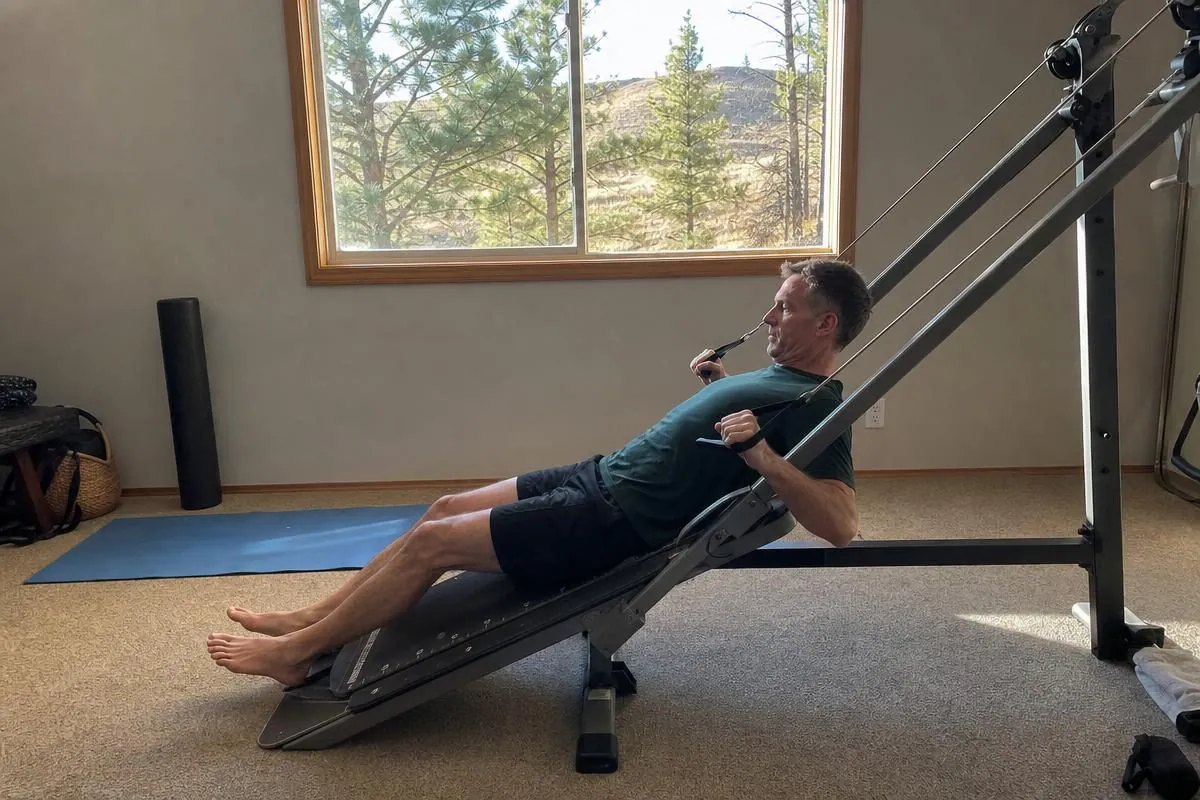
What Is a Total Gym, and Where Does the Resistance Come From?
Resistance comes from the incline, not from plates or bands. Raise the rail and a bigger share of your body weight moves with each rep. Lower it and the load drops. That one adjustable setting is the whole system, so a single frame handles presses, rows, pull-ups, squats, ab crunches, and stretching.
The physics explains two things sales pages rarely spell out. On a slope you only ever lift part of your body weight, so a 180 lb user never presses 180 lb, even at the steepest setting. And the load scales with the person: a 120 lb user and a 220 lb user on the same level get very different workouts.
Because the load rides on the board with you, each rep starts smoothly instead of yanking a cable. That low-jolt feel is why the design found a place in physical therapy clinics.
Total Gym Models Compared: EVOLVE, FIT, APEX, and XLS
Total Gym Direct, the brand’s consumer store, listed three home models in October 2026, and two more still turn up at retailers:
| Model | Resistance levels | Max user weight | Listed exercises | Best fit |
|---|---|---|---|---|
| EVOLVE | 16 | 500 lb | 100+ | Heavier users wanting the most range |
| FIT | 12 | 450 lb | 85+ | Most buyers; the brand’s most popular |
| APEX G5 | 10 (retail listings) | 375 lb (retail listings) | 80+ | Mid-range, sold at big-box stores |
| APEX G3 | 8 | 300 lb | 70+ | Lighter users, tight floor space |
| XLS | Varies by listing | Varies by listing | Varies by listing | Older model from third-party sellers |
Check the weight limit before the level count. If you sit near a frame’s maximum, step up a model even if you will never use every level. The brand says its gyms arrive fully assembled and fold for easy storage, so little assembly is required.
Which Total Gym Suits a Beginner or Senior?
For a beginner or an older adult, the APEX G3 or FIT is the usual starting point: begin at the lowest incline and add one level at a time. If getting down to the board is hard, the glideboard’s height off the floor matters more than extra levels, so compare that dimension on the listing. Already lift weights? Skip the G3, because its top level will feel light quickly. Anyone with osteoporosis, a joint replacement, or a recent injury should clear the program with a doctor or physical therapist first.
A Three-Day Workout Schedule That Suits the Incline
Three sessions a week, each aimed at different muscles, fits most fitness levels:
- Day 1, upper body workout: chest press, seated rows, pull-ups, and triceps presses, 2 to 3 sets each.
- Day 2, legs and core: two-leg and single-leg squats (the second also trains ankle stability), calf raises, and ab crunches.
- Day 3, full body circuit: 30 to 45 seconds per exercise with short rest, which adds a cardio effect to the strength work.
Progress by raising the incline one level once every set feels clean, not by adding reps forever. A Pilates attachment adds a lighter fourth day of core and mobility work, but accessories are not universal across frames, so confirm compatibility first. For guided sessions, Total Gym TV streams trainer-led, on-demand workouts by monthly or annual subscription.
Prefer a set program? Compare Tony Horton’s P90X, which uses dumbbells and bands instead.
Where the Incline Machine Falls Short
It will not replace a loaded barbell. The heaviest setting is still a fraction of your body weight, so strong lifters run out of load long before they would on a squat rack or bench press. To build muscle past an intermediate level, the weight-based Bowflex lineup or free weights will carry you further.
Weight loss is the other overpromise. A circuit on the board burns calories like any moderate strength session, but diet and daily activity decide whether you lose weight, as the site’s look at whether as-seen-on-TV products work explains.
Where it does excel: functional training, joint-friendly strength and resistance training, and replacing a rack, bench, and dumbbells with one machine on a steel frame.
From a 1974 San Diego Design to Late-Night TV
San Diego engineers built the first unit in 1974, with Tom Campanaro credited as inventor. The first TV commercial aired in 1976, the company moved into physical therapy in 1988, and a 1996 deal with American Telecast Products produced the first infomercial, starring Chuck Norris and Christie Brinkley. Wikipedia puts sales at more than 4 million units; the company’s own site now claims over 5 million.
That pitch landed in the peak era of 1990s TV pitches. It sits beside classics like the ThighMaster and the George Foreman Grill. For the backstory, see what an infomercial is and the pitchmen who sold them.
Where to Buy a Total Gym Today
The maker, Total Gym Fitness LLC, sells the home lineup through its direct store, which listed a 30-day risk-free trial, free shipping, and sales of up to 65% off in October 2026, so treat any list price as a starting point. The machine also sells on Amazon, at Walmart, and through the manufacturer’s outlet store on eBay. Compare current prices below. As an Amazon Associate, allfromtv.com earns from qualifying purchases.
- FIT: Check price on Amazon
- XLS: Check price on Amazon
- APEX: Check price on Amazon
Warranty terms and customer service differ between the direct store, big retailers, and marketplace resellers, so ask before ordering, especially on an older XLS.
Measure your floor space first, then buy the total gym that matches the user weight and resistance range you will need six months from now, not today. For gentle strength work, the APEX line covers it; for streaming classes and the widest range of moves, go to the FIT or EVOLVE.
Frequently Asked Questions About the Total Gym
Can you build muscle on it?
Yes, for beginners and intermediate users. Incline resistance builds strength and some size early on, but the load is capped at a fraction of body weight, so advanced lifters gain more from heavier free weights.
Is it like a Pilates reformer?
It feels similar, since both use a carriage that glides on a rail. A reformer uses springs for resistance, while this machine uses your body weight on an incline.
How often should you use it?
Three or four sessions a week works for most people. Daily use is possible if you alternate muscle groups, since training the same muscles hard on back-to-back days slows recovery.