
Hillsdale College is a small private liberal arts college in southern Michigan, founded in 1844, and best known for refusing all federal and state funding. If you’ve seen the Hillsdale College infomercial running on Fox News, Newsmax, OAN, or conservative talk radio, you’re watching one of the longest-running direct-response campaigns in higher education. The pitch usually points viewers toward free online courses, the free Imprimis monthly speech digest, or undergraduate admissions. Here’s a neutral look at what’s actually behind the ads.
The history of the Hillsdale College infomercial
The school’s marketing arc tracks closely with its institutional choices. Hillsdale opened in 1844 as a Free Will Baptist foundation in Hillsdale, Michigan, and built an early reputation for admitting Black and female students before the Civil War. Today it’s nondenominational and independent.
The pivotal moment for the school’s public identity came in 1972. After the federal government argued that Title IX compliance reporting applied to Hillsdale because some of its students used federal aid, the college fought the requirement and eventually decided to refuse all federal and state funding outright. That includes Pell Grants and federal student loans. The school self-funds through tuition, donations, and its endowment, which has grown into the high hundreds of millions in recent reporting.
In 1972 the college also launched Imprimis, a monthly speech digest that reprints talks given at on-campus events. It’s mailed free to anyone who asks, and the subscriber list now reportedly tops six million. That mailing list is the foundation of the school’s national fundraising program.
Through the 1980s and 1990s, Hillsdale leaned harder into direct mail and donor cultivation. The 2010s brought the bigger shift: heavy direct-response TV expansion onto conservative cable news networks and AM talk radio, plus the launch of free online courses under the Hillsdale Online banner. Those free courses are usually the call to action in the TV spots. By the mid-2020s the campaigns also leaned on the K-12 charter schools the college helps launch through its Barney Charter School Initiative.
As of May 2026, the Hillsdale College infomercial is still airing nationally on Fox News, Newsmax, OAN, and across conservative talk radio. Different cuts emphasize Imprimis, the free online courses, or the residential undergraduate program.
What Hillsdale College actually offers
The ads point at several different products, and they aren’t interchangeable. Here’s what each one really is.
Undergraduate residential college. Roughly 1,500 students live and study on the Hillsdale, Michigan campus. The curriculum is classical liberal arts with a required core in Western civilization, US Constitution, rhetoric, and the great books. Class sizes are small and faculty access is a real selling point. Because the school refuses federal aid, students can’t use Pell Grants or federal student loans. Institutional scholarships and outside private aid are the only routes.
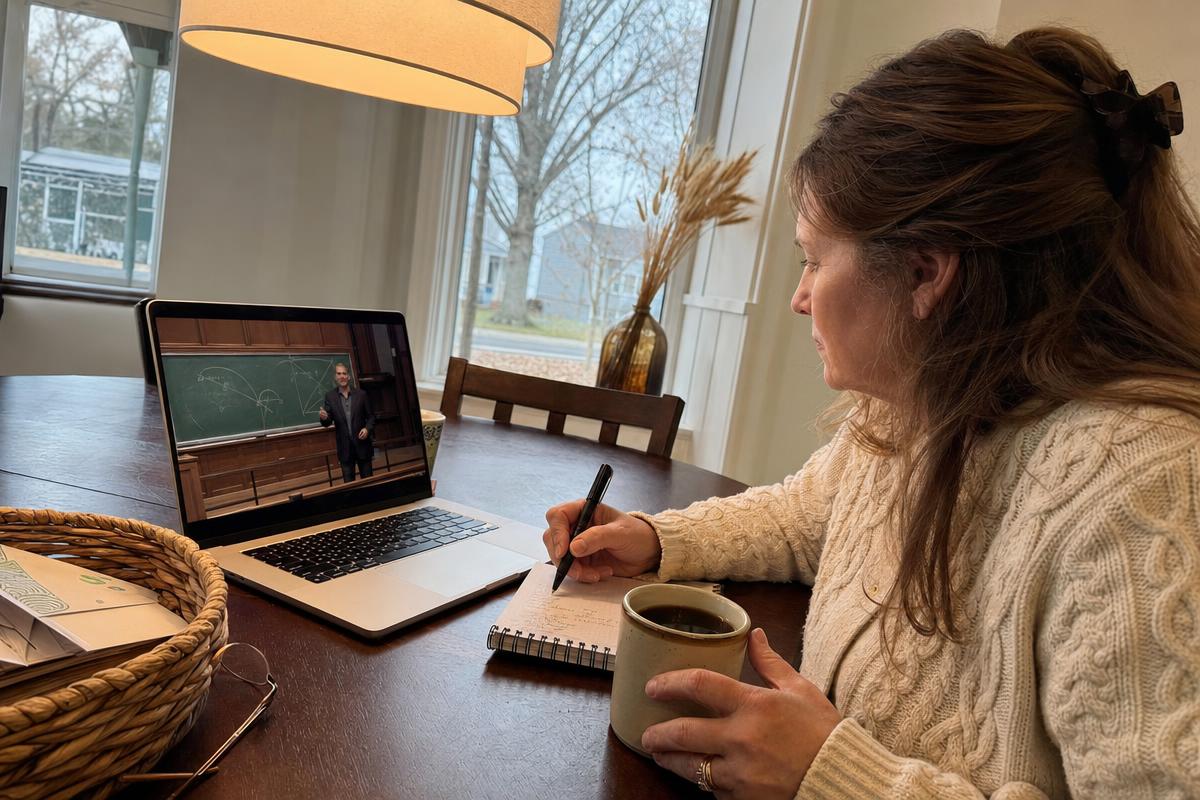
Hillsdale Online. This is the most directly accessible offering for TV viewers. The school has published several dozen free, non-credit online courses on topics like the Constitution, American history, Western philosophy, classical economics, and the great books. They’re taught by sitting faculty, not licensed third-party content. You sign up with an email address and watch on your own schedule. There’s no degree credit attached, no transcripts, and no exams that count toward anything.
Imprimis. A monthly speech digest mailed free to roughly six million subscribers. Each issue reprints one talk given at a Hillsdale-hosted event. It’s not a magazine, and it’s not advertising-supported.
Barney Charter School Initiative. The college helps launch and support classical-curriculum K-12 charter schools across the country. The schools are independently operated but use Hillsdale’s curriculum templates and teacher support.
Van Andel Graduate School of Government. A small, focused graduate program in Washington, D.C., offering master’s and doctoral degrees in politics and statesmanship. Cohorts are tiny.
| Offering | Cost | Audience | What you get |
|---|---|---|---|
| Undergraduate residential | ~$50k-$55k/year sticker | Traditional college applicants | 4-year classical liberal arts degree, accredited |
| Hillsdale Online | Free | Anyone with email | Non-credit video courses, no degree |
| Imprimis | Free | General readers | Monthly speech digest by mail |
| Barney Charter Schools | Free public-school tuition | K-12 families in served districts | Classical-curriculum public charter |
| Van Andel Graduate School | Tuition varies, scholarships available | Graduate students | MA/PhD in politics and statesmanship |
Hillsdale College reviews: what students and viewers praise
The most common positive reviews land in a few specific places, and most of them hold up under scrutiny.
The free online courses are real. They’re taught by sitting faculty members, recorded with reasonable production quality, and cover meaningful syllabus content. You won’t get academic credit, but you also aren’t paying anything, and the lectures aren’t repackaged third-party material.
Imprimis is a free monthly publication with original content. Every issue is a single speech, edited for print. You can subscribe at no cost and unsubscribe whenever. There’s no ad load.
Small classes and accessible faculty for residential undergrads. With roughly 1,500 students on campus, professors actually know their students. That’s a structural advantage versus large state universities.
Solid graduate-school placement and government-track outcomes. Alumni land in respected law schools, doctoral programs, and policy and political roles at higher rates than the school’s size would predict. That’s partly self-selection (motivated applicants) and partly the alumni network.
Federal-aid independence is the institutional identity. Some families want a school that’s structurally insulated from changes in federal regulation, and Hillsdale is one of a very small number of US colleges that actually delivers that. That’s not a marketing claim; it’s a balance-sheet fact.
Hillsdale College reviews: common criticisms
The criticisms are also worth taking seriously, and they’re separate from politics.
Sticker price is high and federal aid isn’t an option. All-in cost runs roughly $50,000 to $55,000 per year for tuition, room, and board. Because the college refuses federal funding, students can’t use Pell Grants, federal subsidized or unsubsidized loans, or PLUS loans. Institutional scholarships and outside private aid are the only paths to discount, and not every family qualifies for enough to close the gap. Compared to a flagship state university with full federal aid stacking, the net price for a middle-income family can be meaningfully higher.
Limited curricular viewpoint diversity. Academic peer reviews and student-experience reports consistently note that the institutional perspective is narrow. The classical curriculum is rigorous within its tradition, but you won’t encounter the same range of contemporary critical theory, comparative methodologies, or progressive-tradition primary texts you’d find at a typical liberal arts peer. For some students that’s a feature; for others it’s a real limitation, especially if you plan to enter a graduate field that expects exposure to those debates.
Charter school controversies in 2024. The Barney Charter School Initiative had a tough year. Florida’s instructional materials review flagged elements of the Hillsdale-aligned curriculum during a state textbook adoption cycle. In Tennessee, the Lee County school board had public friction over a proposed classical charter, with the board ultimately splitting on whether the alignment matched local priorities. None of that closed the network, but it complicated the rollout in several states.
The TV ads can over-promise the online courses. The free courses are genuinely substantive, but they don’t carry credit, don’t lead to a credential, and can’t substitute for a transcript. Some viewers walk away from the ads expecting more transferable academic value than the courses are designed to deliver.
Is Hillsdale worth attending or watching?
It depends on which offering you’re actually considering.
If you’re a prospective undergrad, Hillsdale is a serious classical education with strong outcomes for the right student profile. That profile is motivated, self-directed, comfortable with the institution’s identity, and either able to absorb the sticker price or able to compete for institutional aid. Visit in person before committing. Sit in on classes. Talk to current students who aren’t on the admissions tour. The fit question is bigger here than at most schools because the curriculum is unusually shaped.
If you’re an online learner, Hillsdale Online is a legitimate free-education resource. You’ll get real college-level lectures with no credit attached, no exams that matter, and no cost. If the topics interest you (the Constitution, classical philosophy, Western history, the great books), it’s worth signing up. Treat it like a podcast on steroids, not like a degree pathway.
If you’re an Imprimis subscriber, it’s a free monthly speech digest. Low friction to start, low friction to stop. You’re trading your mailing address for the subscription, which means you’ll also get fundraising mail.
The Hillsdale College infomercial is doing what direct-response advertising is built to do: pull viewers into a free offering and then convert a small percentage to donors. Knowing that going in lets you take what’s useful and skip the rest. A reasonable next step is to sign up for whichever single product you actually want, on the school’s own site, and ignore the upsells you don’t.
Frequently asked questions
Is Hillsdale College accredited?
Yes. Hillsdale is regionally accredited by the Higher Learning Commission. Its bachelor’s degrees are recognized by graduate schools and employers like any other accredited US institution.
Are Hillsdale’s online courses really free?
Yes. The Hillsdale Online courses are free to enroll and free to watch. There’s no credit card required and no upsell to a paid tier. The school will email you about donation opportunities, but the courses themselves stay free.
How much does Hillsdale College cost?
Sticker price for tuition, room, and board runs roughly $50,000 to $55,000 per year as of recent reporting. Institutional scholarships and outside private aid are the only ways to discount it, since federal aid isn’t accepted.
Why doesn’t Hillsdale accept federal funding?
The college decided in the 1970s that accepting federal money came with regulatory strings it didn’t want, starting with Title IX compliance reporting. Refusing federal and state funding keeps the school outside that regulatory framework.
Is Hillsdale a religious college?
No, not formally. It was founded by Free Will Baptists in 1844 but is now nondenominational. There’s no religious requirement for admission and no required chapel. The curriculum does engage classical Christian texts as part of Western civilization study.
Where is Hillsdale College located?
The main campus is in Hillsdale, Michigan, a small town in the south-central part of the state, roughly two hours west of Detroit and two hours northwest of Toledo. The Van Andel Graduate School of Government is in Washington, D.C.
Can I get college credit from Hillsdale Online?
No. The free online courses don’t carry academic credit, don’t produce transcripts, and don’t transfer to other schools. They’re non-credit educational content, useful for personal learning but not for a credential.
Where to learn more
For current course catalogs, admissions deadlines, Imprimis subscription, and the latest TV schedule, head to the official Hillsdale College website. That’s the only place where pricing, course rosters, and program details are kept current.