
A Generac home standby generator is a permanently installed backup power system that sits outside your house, runs on natural gas or liquid propane, and auto-starts within roughly 10 seconds of a utility outage. If you’ve seen the generac home standby infomercial during a recent storm warning, you’ve probably wondered whether the pitch matches reality. This page breaks down what Generac actually sells, what installed costs really look like in 2026, what owners praise, what they complain about, and whether a permanent standby unit makes sense for your house.
The history of the Generac infomercial
Generac Holdings was founded in 1959 by Robert Kern in Wisconsin, and it’s still headquartered in Waukesha. The original business was industrial generators sold to OEMs and commercial sites. For decades, the residential side was a small slice of revenue, and the brand was barely visible to homeowners outside of trade catalogs.
That changed in the 2000s. Generac pivoted hard into the residential standby category, betting that suburban homeowners would buy permanent backup power if it was easy to install and finance. The marketing strategy followed the weather. After Hurricane Katrina in 2005, demand spiked across the Gulf Coast. After Superstorm Sandy in 2012, demand spiked across the Northeast. After Hurricane Harvey in 2017, demand spiked again across Texas. Each event got Generac more shelf space at Home Depot and Lowe’s, and more airtime on cable.
The infomercial format matured around that pattern. Storm-season DRTV (direct response TV) buys ramp up in late spring across hurricane-belt states, then shift to ice-storm and wildfire-PSPS regions in the fall and winter. The creative is consistent: a homeowner stands in a dark kitchen, the lights flicker, the Generac kicks on, the family keeps eating dinner. Call this number, get a free in-home assessment, financing available.
2022 brought a setback. Generac issued a major recall on portable generators tied to a saddle-tank fire risk that affected millions of units. The recall didn’t touch the home standby line, but it dented brand trust and got covered widely in consumer press. Generac kept advertising through it.
By 2026, the infomercials are still running nationwide during storm season, with Mobile Link wifi monitoring as the current marketing hook. The pitch now leans on the smartphone app and self-test alerts as much as the storm-recovery story.
What Generac actually offers
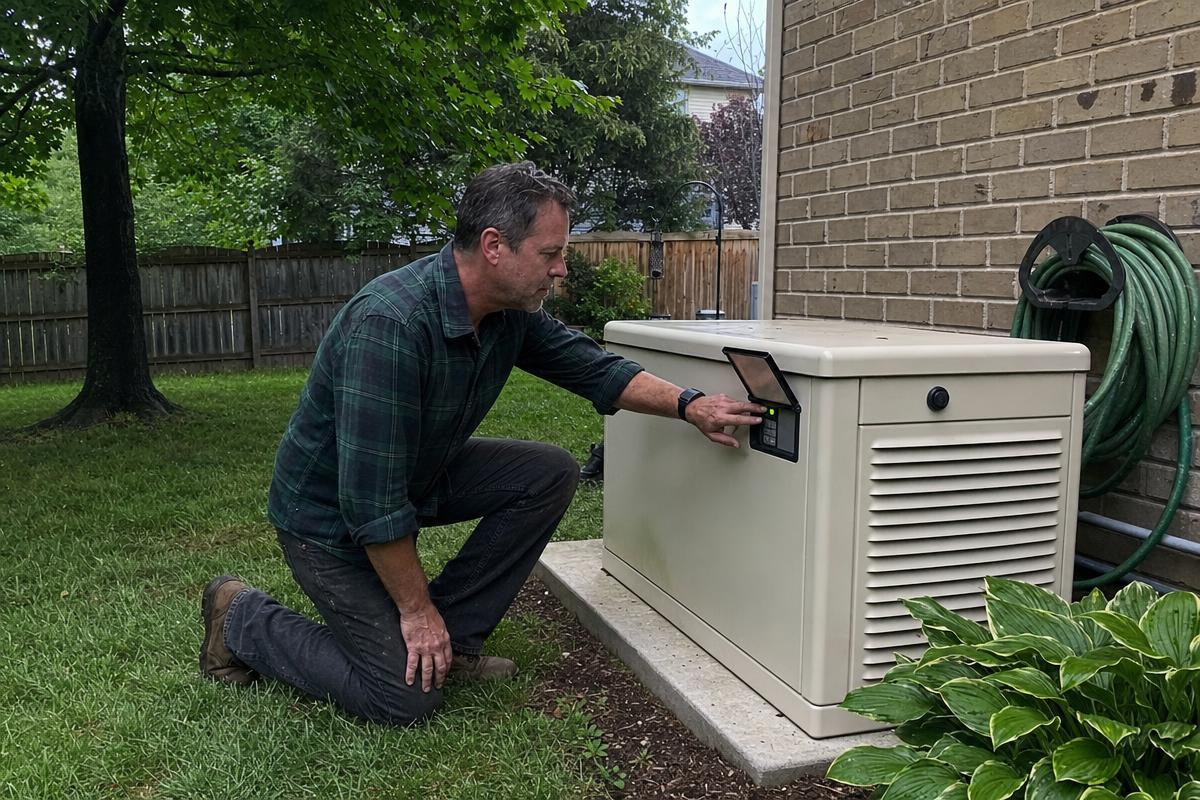
It helps to know the categories before you shop. A portable generator is the wheeled unit you roll out of the garage and fill with gasoline. An inverter generator is a smaller, quieter portable that produces cleaner power for sensitive electronics. A standby generator is permanently bolted to a concrete pad outside the house, hardwired to your electrical panel through an automatic transfer switch, and fueled by your gas line. The infomercials advertise the third category.
The Guardian series is Generac’s most common residential line. Sizes run 7 kW, 10 kW, 14 kW, 18 kW, 22 kW, 24 kW, and 26 kW. Smaller air-cooled units handle critical circuits like the fridge, furnace blower, and a few outlets. Mid-size units cover most of a typical suburban home. The 22 kW and above units are usually marketed as whole-home solutions paired with a 200A automatic transfer switch.
Air-cooled engines are the standard residential choice up through 26 kW. Liquid-cooled units start around 32 kW and run up to roughly 60 kW for large homes or small commercial sites. Liquid-cooled costs more, lasts longer under heavy load, and is overkill for most houses.
PWRcell is a separate product line, not a generator. It’s a lithium battery storage system designed to pair with solar or to run independently as a short-duration backup. It’s quiet and emissions-free but doesn’t replace a fuel-burning standby unit for multi-day outages.
Every standby install includes the generator, a Generac automatic transfer switch (ATS), and Mobile Link wifi monitoring with a companion app for alerts on self-tests, low-fuel warnings, and fault codes.
| kW Size | Best Suited For | Approx Equipment Price | Approx Total Installed |
|---|---|---|---|
| 7-10 kW | Critical circuits only (fridge, furnace, lights) | $2,000-$3,500 | $5,000-$8,000 |
| 14-18 kW | Most circuits in a small to mid-size home | $3,500-$5,500 | $8,000-$12,000 |
| 22-24 kW | Whole-home for typical suburban homes | $5,500-$7,500 | $12,000-$17,000 |
| 26 kW | Whole-home for larger homes with central AC and electric appliances | $7,500-$9,000 | $15,000-$20,000 |
Generac reviews: what owners praise
The single most common positive in owner reviews is reliable auto-start during outages. Most owners report restoration in the 5-to-10 second range, which is fast enough that desktop PCs may reboot but fridges, HVAC, and lights ride through with no manual effort. For people who travel or who have older relatives at home, that hands-off behavior is the whole reason they bought the unit.
Mobile Link wifi monitoring gets consistent praise. Owners get text or app alerts when the weekly self-test runs, when fuel pressure drops, when a fault code triggers, and when the unit transitions to backup power. You can be at the office and see that your house went on backup at 2:14 PM. That visibility is a meaningful upgrade over older standby units that just sat there silent.
Noise is better than people expect on the larger Guardian units. The 22 kW through 26 kW models typically run around 60 to 70 dB at 23 feet, which is comparable to a normal conversation or a window AC. Smaller air-cooled units are louder per kW. Owners in dense neighborhoods almost always recommend going slightly larger for the noise improvement.
Whole-home 200A coverage is achievable with a properly sized 22 kW or 24 kW unit and a matching ATS. You can run central AC, electric range, well pump, and the rest of the house simultaneously without load-shedding. Generac’s dealer network is broad, so service is usually available within a reasonable drive in most US metros.
Generac reviews: common complaints
The biggest complaint by a wide margin is total installed cost. Buyers walk in expecting $8,000 to $10,000 because that’s roughly what the equipment costs at retail. They walk out with a quote of $15,000 to $20,000 because installation includes a concrete pad, a gas line extension and pressure test, an electrical permit, an inspection, the automatic transfer switch, conduit, labor, and dealer markup. The infomercial doesn’t lie about this, but it doesn’t lead with it either, and the gap between expectation and reality is the number one source of buyer regret.
Dealer pricing variance is the second complaint. Owners who got three quotes routinely report $3,000 to $5,000 differences for the same kW unit on the same lot. Generac doesn’t set installed prices. The dealer does. If you take the first quote, you have no idea whether you paid market or paid a premium.
The 2022 portable generator recall still comes up in reviews even though it’s a different product line. Generac recalled millions of portable units over a saddle-tank fire risk, and consumer-press coverage was heavy. Standby owners aren’t directly affected, but the recall hurt brand trust and shows up in skeptical reviews.
Maintenance is another sore spot. A dealer-serviced annual maintenance kit (oil, oil filter, air filter, spark plugs, valve adjustment on schedule) typically runs $300 to $500 per visit, and over the unit’s life that adds up to $1,000 to $1,500 annually if you’re also doing extended-interval service. DIY owners can cut that significantly, but warranty terms sometimes push people back to the dealer.
Mechanical issues on smaller air-cooled units (governor surges, voltage regulator faults, controller board glitches on older firmware) show up in a meaningful share of negative reviews. They’re not majority complaints, but they’re not rare either. Permit and inspection delays during installation, sometimes stretching the project to 8-to-12 weeks, are also frequent gripes.
Is Generac home standby worth it?
Honest answer: it depends on your outage profile and what’s at stake when the power goes out. A permanent standby unit makes the most sense for homes that lose power multiple times a year for hours at a stretch, or for households with critical medical equipment like CPAP machines, oxygen concentrators, refrigerated insulin, or dialysis supplies. In those cases the auto-start, hands-off behavior is genuinely worth the installed cost, and the math works out fast.
For households with one or two short outages a year and no medical needs, a $15,000 to $20,000 install is hard to justify. A 7,500-watt portable with a manual transfer switch covers critical circuits for around $1,500 to $3,000 total. A PWRcell or competing battery system covers short outages silently and emissions-free for $10,000 to $15,000 installed and pairs nicely with solar. Both are 30 to 80 percent cheaper than a Generac standby install and cover the realistic outage pattern most homeowners actually face.
If you’ve decided you want a standby unit after watching the generac home standby infomercial, the single most important step is to get three written quotes from different dealers before signing. Pricing variance is large, financing terms vary, and the unit you actually need (kW size, ATS amperage) depends on a real load calculation, not an infomercial pitch.
Frequently asked questions
How much does a Generac home standby generator cost installed?
Total installed cost typically runs $8,000 to $20,000 in 2026. Equipment alone is $2,000 to $9,000 depending on kW size. Installation adds $5,000 to $11,000 covering the ATS, concrete pad, gas line extension, electrical work, permits, and labor. Whole-home 22-26 kW setups commonly land in the $15,000 to $20,000 range.
What size Generac do I need for my house?
It depends on your square footage, HVAC load, and whether you want critical-circuit or whole-home coverage. A 14 kW unit covers most of a small home. A 22-24 kW unit handles whole-home for a typical suburban house with central AC. A 26 kW unit fits larger homes or homes with electric ranges and well pumps. A licensed electrician should run a real load calculation, not a guess.
How long does a Generac standby generator run?
If it’s connected to your natural gas line, it can run essentially indefinitely as long as gas pressure holds. On liquid propane from a residential tank, runtime depends on tank size and load. A 500-gallon LP tank at half load typically lasts 5 to 7 days. The unit will run a brief weekly self-test on its own, regardless of whether the power is out.
Does Generac use propane or natural gas?
Both. Most residential Guardian units are dual-fuel and field-convertible between natural gas and liquid propane. Natural gas is more common in suburban areas with utility gas service. LP is common in rural areas and is the default if the home has an existing propane tank for heat or cooking.
How loud is a Generac generator?
Larger Guardian 22-26 kW units typically measure around 60 to 70 dB at 23 feet during normal operation, which is comparable to a window AC or a normal conversation. Smaller air-cooled units are louder per kW. The weekly self-test runs at idle and is quieter than full-load operation.
Is the 2022 Generac recall related to home standby units?
No. The 2022 recall covered portable generators with a saddle-tank fire risk. The home standby Guardian line was not part of that recall. The brand impact was real, but the standby product line was a separate issue.
How often does a Generac standby need maintenance?
Annual service is the baseline: oil change, oil filter, air filter, spark plug check, and a valve adjustment on the recommended interval. Dealer-serviced kits typically run $300 to $500. DIY is cheaper if you’re comfortable working on small engines and your warranty allows it. The unit’s controller will flag service intervals through the Mobile Link app.
Where to learn more
For full product specs, dealer locator, and current promotions, visit the official Generac website. Cross-check any dealer quote against the published equipment prices and ask for an itemized breakdown of installation costs before signing.